
After the Star, Taste
Coloniality of Taste, part 2

In the context in which I grew up, eating at a restaurant was just one of many gastronomic experiences the city had to offer. Because my parents worked full time during the week, family life was concentrated on weekends. We rarely stayed at home; as if the rooms of our apartment were cells, the city became the playground that had to be explored.
Like many middle-class families in a city such as Mexico City, we regularly went out for breakfast in the mornings, usually to a Vips or a Sanborns. These establishments offered complete breakfasts: scrambled eggs, fried eggs, huevos divorciados, eggs prepared in every possible way. While the food was being prepared, I would wander off to the magazine section, where I could spend long stretches of time reading video game magazines or children’s publications that taught a little about everything: ecosystems, curiosities, what other cities were like, how people lived in other countries.
Around eleven or noon, my parents would decide to go to the cinema—there was a period when we went every single weekend—and later in the afternoon we would go out to eat. These were not fancy places where reservations were required in advance, nor restaurants recommended by some gourmand in the newspaper. They were recommendations from friends, work colleagues, or simply spontaneous decisions: stopping at a street food stand on a random corner of the city and trying the house specialties.
My favorite places were the markets, with their many stalls selling garnachas, seafood, or smoothies in infinite flavors, made possible by the vast variety of fruits and vegetables. I was also drawn to the food stalls run by women who would lure you in with their voices and their extensive menus as soon as you approached: giant quesadillas, chicken soups, menudo, pozole. These experiences, beyond the dish itself, invited one to linger, to talk, to exchange points of view, to improvise. Sometimes even a friendship would form. Hospitality emerged through a horizontal relationship between the cooks and their customers.
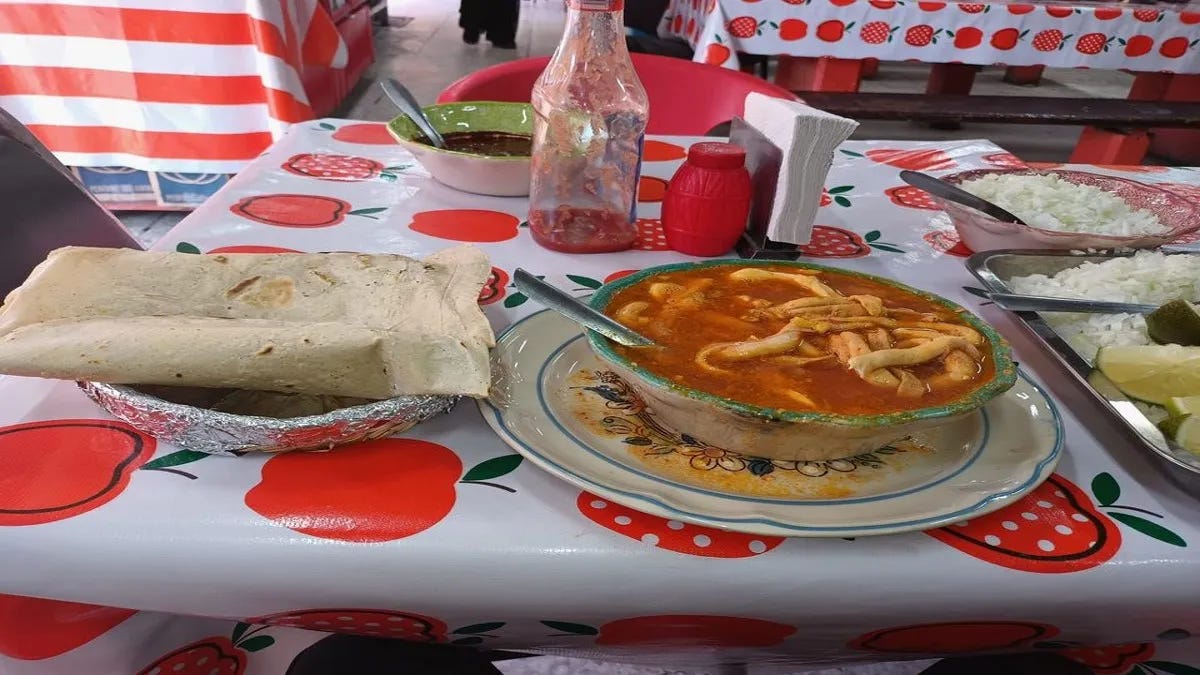
Mercado Pantaco in Mexico City and its communal tables. Huge dishes and giant tortillas. It is said that if you manage to finish twenty of those tortillas, the meal is free.
Mexico City, a monster with a thousand heads—perhaps today that monster has given birth to children that are themselves little monsters with a thousand heads—houses an endless range of gastronomic offerings: from the most conventional, such as Sanborns and Vips branches, to street stalls—with or without permits—offering an enormous diversity of dishes and flavors. Markets, tianguis, bars, cantinas, fondas, fast food, migrant food, takeout, food shared among friends, barbecues, birthdays, family gatherings, breakfasts with my grandmothers.
Restaurants, of course, were present, but with or without them, the aesthetic experience of eating was not centralized around an individual table. Eating did not demand a narrative or an explanation; it happened as part of urban movement. It was perhaps between the ages of eighteen and twenty that restaurants became more habitual, just one more possibility within the range offered by that—or those—monsters.
From the 2010s onward, with the rise of social media, multiple voices began to emerge, gradually reviewing the places they visited. No formal culinary training was necessary: likes and followers became the new parameters for assuming the role of gourmand. The duality between gourmand and glutton, as well as the boundary between both ethos, gradually blurred until it became almost irrelevant. Language—the culinary argot—also transformed: emojis, reactions, metrics, trends, algorithms. The contemporary regime of taste became a regime of visibility.
The gourmand of the past positioned himself as a “universal” expert of taste. Refined, generally male, he was someone who, thanks to his intellect, could perceive the complex flavors crafted by chefs in major European cities. His counterpart, the glutton, was a body that desired without cultural mediation; his voracious impulse prevented him from recognizing what a dish represented beyond immediate satisfaction. Since the nineteenth century, taste had to be disciplined, educated in flavors, ingredients, and trajectories. The gourmand thus circulated among restaurants deemed worth visiting: fine dining, haute cuisine, or, alternatively, gastronomic journeys to “virgin” lands where “exotic” or “authentic” dishes were promised, recommended by yet another explorer.
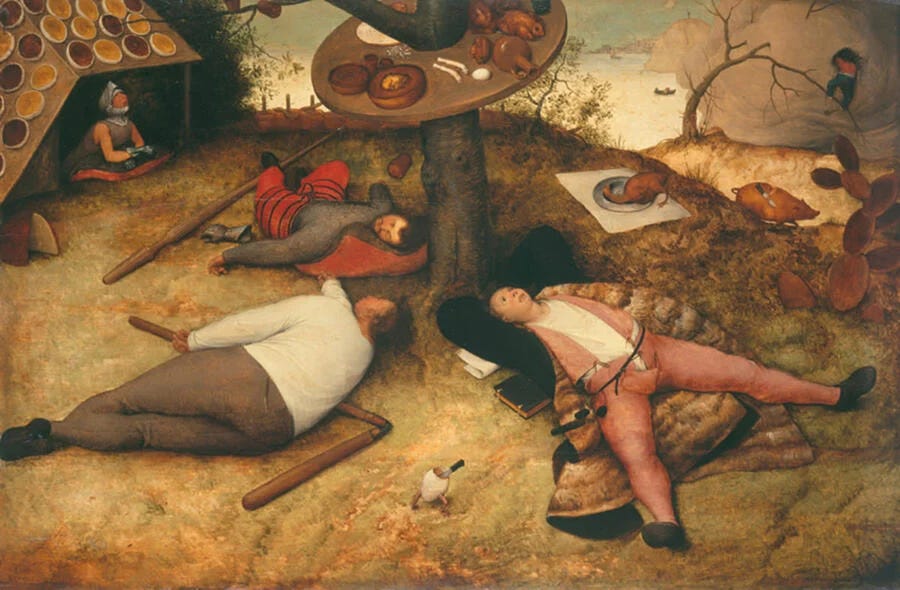
Pieter Bruegel the Elder, The Land of Cockaigne, 1567
Today, the foodie or content creator appears as a more “savage” figure. Their motivations are different and push them to visit restaurants of all kinds. Language is tightly bound to trends and algorithms: “This is the best restaurant in the neighborhood,” “this might be the best dish I’ve ever eaten in my life,” “where to eat authentic food in this place.” These phrases are designed to immediately capture the gaze, to seduce it with food porn photographs. The algorithm does not eliminate hierarchies of taste; it accelerates and automates them.
Perhaps it is in our present moment that the gourmand and the foodie have become two sides of the same coin: a Mr. Jekyll and Hyde, a Victor and Frankenstein, split dualities that inevitably reunite under the same context: the restaurant. Today, the restaurant is no longer just a place where one eats, but a machine that produces narratives, hierarchies, and visibility; a device that concentrates attention and translates experience into shareable content.
But what about the other scenarios of social interaction around food? What happens to urban and domestic spaces where exchanges, relationships, and experiences also take place? They do not produce content, or they lack sufficient media appeal; they do not generate the same reactions or the same number of likes. Not because they lack intensity, but because they do not translate easily, they resist.
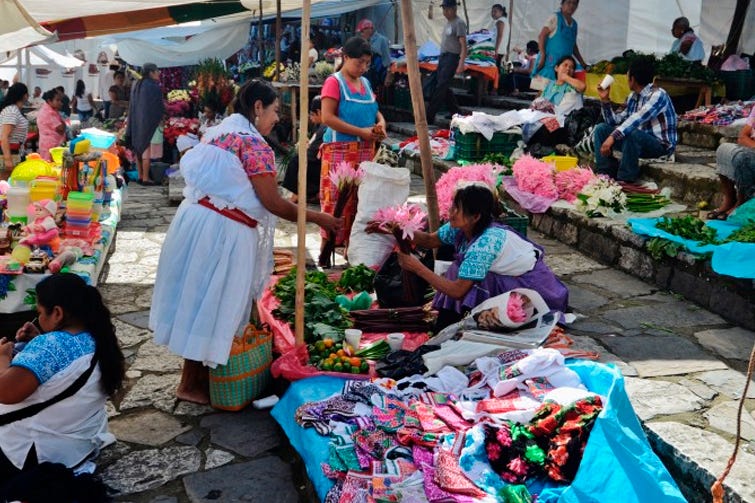
Tianguis. itinerant markets whose origins trace back to Mesoamerican societies, where goods of all kinds were exchanged through barter.
The city—and here I am not speaking only of Mexico City, but also of other cities—as a monster with a thousand heads offers no clear narrative, no unified experience, no dishes of excellence. It is simultaneous, chaotic, contradictory. There are no guides or manuals for approaching this monster; it is the responsibility of the explorer to dare to leap into the void, without expectations, without Google Maps reviews or TripAdvisor recommendations. The monster with a thousand heads does not fail the system; the system fails when it attempts to domesticate it. In a media ecosystem that privileges the recognizable, the repeatable, and the recommendable, the monster persists as a form of resistance, not because it openly opposes, but because it refuses to be simplified.
I speak from a formation of taste that was not educated to recognize excellence, but to move among contradictions, repetitions, and shared affects. From that position, the restaurant returns to its place: one among many, not the center of the gastronomic experience.
Post-Tenebras Lux or After the Star, Taste?
By the way, I should mention that although my cousin Michelin did not invite me to his ceremony last Monday, he did call me a few hours before the event to ask for a dish recommendation to share with his guests. I gladly suggested some proper tongue tacos with green salsa. Later, I learned that he had only partially followed the idea, serving tongue tacos with chimichurri and flour tortillas. I can only assume this was not a deliberate act of fusion, but a moment of culinary improvisation: flour tortillas from Tesco, no corn tortillas to be found, no tomatillos for the salsa, and chimichurri standing in as a convenient substitute.